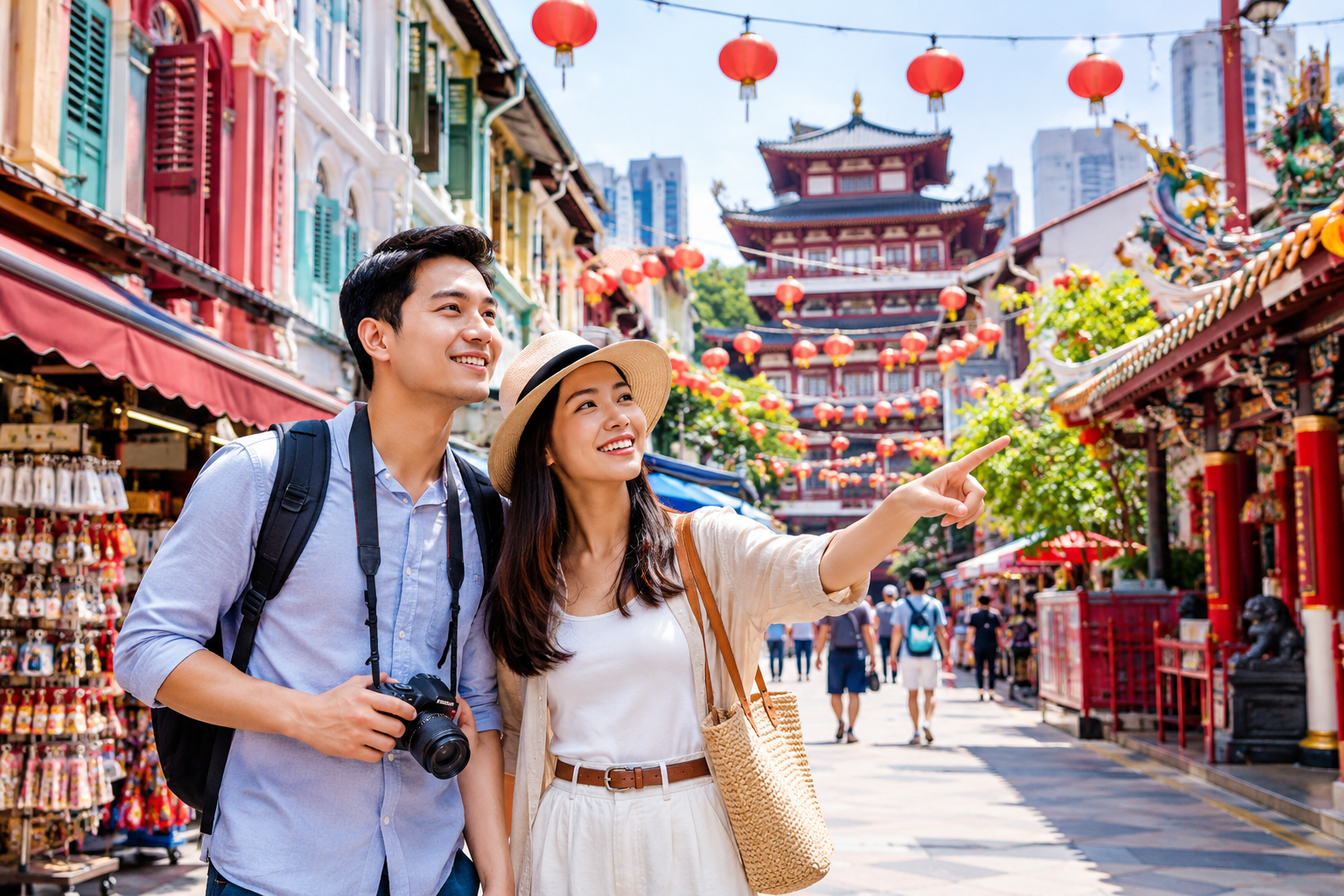
A Journey Through Heritage, Culture, and Community
Introduction: Discovering the History of Chinatown Singapore
The history of Chinatown Singapore is one of the most fascinating stories in the development of the city-state. Located in the heart of Singapore, Chinatown is more than a popular tourist destination filled with traditional buildings, restaurants, temples, markets, and colorful streets. It is a living representation of Singapore’s multicultural history and the important role played by Chinese immigrants in shaping the social, economic, and cultural development of Singapore.
For visitors searching for the best historical places in Singapore, Chinatown Singapore offers a unique opportunity to experience the past while walking through a modern city. The area combines Chinese heritage, colonial architecture, religious landmarks, traditional food, local businesses, and modern lifestyle attractions. Every street and historic building tells a story about migration, family, hard work, cultural traditions, and the transformation of Singapore.
Understanding the history of Chinatown Singapore also means understanding a significant part of Singapore’s national history. Chinese immigrants arrived in Singapore in large numbers during the nineteenth century, creating communities, businesses, associations, religious institutions, and neighborhoods. Over generations, these communities became an important part of Singapore’s identity.
Today, Chinatown remains one of the most recognizable heritage districts in Singapore. Although the neighborhood has changed dramatically over time, its historical character continues to attract visitors from around the world.
The Early Development of Singapore
Before Chinatown became the vibrant heritage district known today, Singapore was a small trading settlement that gradually developed into an important port. The establishment of a British trading post in 1819 changed the future of the island dramatically.
Singapore’s strategic location at the crossroads of major maritime routes made it attractive to traders, merchants, laborers, and immigrants from different parts of Asia. The growth of the port created employment opportunities and encouraged migration.
Among the largest immigrant communities were people from different regions of China. Many came from southern China, including areas associated with Fujian, Guangdong, Hainan, and other regions. They spoke different languages and dialects and brought their own traditions, religious practices, food cultures, and social organizations.
The arrival of Chinese immigrants played an important role in the economic development of early Singapore. Some worked as laborers, while others became shopkeepers, craftsmen, traders, businessmen, or members of various professional communities.
The growing Chinese population eventually required a dedicated urban space where people could live, work, worship, and establish community networks. This development became closely connected with the emergence of Chinatown.
The Birth of Chinatown Singapore
The story of Chinatown Singapore can be traced to the early planning of the colonial settlement. In the nineteenth century, the authorities attempted to organize Singapore’s growing population into different residential and commercial areas.
The Chinese community became concentrated in an area west of the Singapore River. This district gradually developed into what is now recognized as Chinatown Singapore.
The location was practical because of its proximity to the Singapore River and the commercial center. The river was extremely important to the economy of early Singapore. Goods arrived by boat, merchants conducted business, and workers depended on the port and surrounding commercial activities.
Chinatown therefore developed not simply as a residential neighborhood but also as an important center of trade and employment.
The streets became increasingly busy as more people arrived. Shophouses were constructed to accommodate businesses and families. A typical shophouse could have a shop or workplace on the ground floor and living quarters above.
This traditional urban design became one of the defining characteristics of Singapore Chinatown architecture.
Chinese Immigration and the Growth of the Community
One of the most important elements in the history of Chinatown Singapore is Chinese migration. During the nineteenth and early twentieth centuries, large numbers of Chinese immigrants came to Singapore in search of economic opportunities.
Life was not always easy for these early migrants. Many left their hometowns because of poverty, political instability, economic difficulties, or limited employment opportunities. Singapore offered the possibility of work and a new beginning.
However, arriving in a new country presented many challenges. Immigrants often had to build new lives from very limited resources.
Community networks became extremely important. People from the same hometown or language group often supported one another. Clan associations, religious organizations, community groups, and social networks provided assistance and helped newcomers adapt to life in Singapore.
These organizations became an important part of Chinatown’s social history.
For many Chinese immigrants, Chinatown was not simply a place to live. It was a place where they could find familiar languages, traditional food, religious practices, business connections, and people who shared similar cultural backgrounds.
This sense of community helped Chinatown develop its distinctive identity.
The Importance of the Singapore River
The Singapore River played a central role in the development of Chinatown and early Singapore. Before modern transportation infrastructure transformed the city, the river was one of the major centers of commercial activity.
Boats transported goods between ships and the riverfront. Warehouses, businesses, and trading establishments developed around the area.
Chinese merchants and workers became deeply involved in the river-based economy. The surrounding streets became crowded with commercial activities, including food businesses, shops, warehouses, and various services.
The river also influenced the physical development of Chinatown.
Walking through the historic district today, it can be difficult to imagine how important the Singapore River once was to everyday economic life. Modern Singapore is dominated by roads, trains, skyscrapers, and sophisticated infrastructure. However, the river remains an important reminder of the city’s origins as a trading port.
The relationship between Chinatown and the Singapore River is therefore essential to understanding Singapore’s economic history.
The Traditional Shophouses of Chinatown
One of the most beautiful features of Chinatown Singapore is its historic shophouses. These buildings are among the most recognizable examples of Singapore’s architectural heritage.
Traditional shophouses were designed for both commercial and residential purposes. The ground floor was usually used for business, while the upper floors provided living space.
Many shophouses feature narrow frontages, long interiors, decorative facades, tiled roofs, windows, shutters, and covered walkways. Their architecture reflects a combination of Asian traditions and influences from the colonial period.
Today, these historic buildings have been carefully conserved in many parts of Chinatown.
Some shophouses have become restaurants, cafes, hotels, shops, galleries, and cultural businesses. This combination of old architecture and modern commercial activity gives Chinatown Singapore a distinctive atmosphere.
For travelers interested in Singapore heritage architecture, Chinatown is one of the most accessible places to experience the city’s historic streetscape.
The preservation of these buildings also demonstrates how Singapore has attempted to balance modernization with cultural heritage conservation.
Religion and the Development of Chinatown
Religion played an important role in the development of the Chinese community in Singapore. Early immigrants built temples and religious institutions that became centers of worship and community life.
One of the most famous religious landmarks in Chinatown is the Buddha Tooth Relic Temple. Its distinctive architecture has made it one of the best-known attractions in modern Chinatown.
Another historically important landmark is Thian Hock Keng, located near the Chinatown area. The temple has strong connections to the Hokkien community and reflects the religious traditions brought by Chinese immigrants.
Chinatown is also remarkable because several different religious traditions can be found within a relatively small area.
The Sri Mariamman Temple, Singapore’s oldest Hindu temple, stands in the Chinatown district. Its presence reflects the multicultural character of the neighborhood and Singapore as a whole.
The Masjid Jamae, also known as Jamae Mosque, is another important religious landmark in the area.
The coexistence of Buddhist, Taoist, Hindu, and Islamic places of worship demonstrates an important aspect of Singapore’s history. Chinatown has never been exclusively about one culture. Instead, it developed within a multicultural environment where different communities lived and interacted with one another.
Chinatown and the Chinese Clan Associations
Clan associations became particularly important in the lives of Chinese immigrants.
Many early Chinese migrants identified strongly with their hometowns, family origins, dialect groups, or regional communities. Clan associations helped members establish social connections and obtain assistance.
These organizations could provide support with employment, housing, welfare, funerals, education, and social activities.
The associations also helped preserve cultural traditions and languages.
In the early history of Singapore Chinatown, such organizations functioned as important social institutions. They created a sense of belonging for immigrants who were living far away from their original homes.
Although modern Singaporean society has changed considerably, the historical role of clan associations remains an important part of the story of Chinese heritage in Singapore.
Everyday Life in Old Chinatown
The history of Chinatown Singapore is not only about temples, merchants, buildings, and famous historical figures. It is also about ordinary people.
For generations, Chinatown was a place where families lived in compact homes above shops. Streets were filled with workers, traders, food sellers, craftsmen, port workers, and small business owners.
The sounds and smells of everyday life became part of the neighborhood’s identity.
Traditional food played a particularly important role. Chinese immigrants brought recipes and cooking techniques from different parts of China. Over time, these traditions adapted to local ingredients and the multicultural environment of Singapore.
This process contributed to the development of Singapore’s distinctive food culture.
Today, visitors to Chinatown can still discover dishes connected to Singapore’s Chinese culinary heritage. Food is therefore more than a tourist attraction. It is a link between generations and a reminder of how migration shaped Singaporean society.
Chinatown During the Japanese Occupation
One of the darkest periods in the history of Singapore was the Japanese occupation during the Second World War.
Singapore was occupied by Japanese forces from 1942 to 1945. The Chinese community experienced severe hardship during this period.
The occupation had a profound effect on Chinatown and the wider Chinese population. Many families suffered from fear, shortages, separation, and violence.
The period remains an important part of Singapore’s wartime history.
Remembering this history helps visitors understand that Chinatown was not always the peaceful heritage destination seen today. The streets that now contain restaurants, museums, and tourist attractions once experienced uncertainty and hardship.
The survival of the community after the war became part of the broader story of Singapore’s recovery and reconstruction.
Post-War Singapore and Social Change
After the Second World War, Singapore entered a period of major political, economic, and social transformation.
Living conditions in many older urban neighborhoods were challenging. Overcrowding and inadequate sanitation were major concerns.
The government introduced large-scale housing and urban development programs. These efforts eventually transformed the way people lived across Singapore.
Many residents moved from older shophouses and crowded neighborhoods into modern public housing estates.
This process changed Chinatown dramatically.
The neighborhood lost some of its traditional residential population as families moved elsewhere. At the same time, the historic buildings and streets became increasingly recognized for their architectural and cultural value.
The transformation created a new challenge: how could Singapore modernize while protecting its historical identity?
Urban Redevelopment and Heritage Conservation
Singapore’s rapid economic development during the second half of the twentieth century transformed the city.
Modern buildings, roads, commercial centers, and housing estates expanded across the island. Some older structures were demolished as part of redevelopment.
However, the value of historic districts gradually received greater attention.
Chinatown became one of the areas where conservation efforts were introduced to protect historic buildings and streets.
Heritage conservation helped preserve traditional shophouses, religious buildings, street layouts, and architectural details.
This conservation process changed Chinatown’s role.
It was no longer simply a neighborhood where a large Chinese immigrant population lived and worked. It increasingly became a heritage district representing the history of Singapore.
Today, Chinatown demonstrates how historic architecture can remain relevant within a modern city.
Chinatown Singapore as a Cultural Heritage Destination
Modern Chinatown Singapore attracts both international tourists and local residents.
Visitors come to explore historic streets, traditional architecture, temples, museums, restaurants, markets, and cultural attractions.
For people interested in Singapore travel, Chinatown offers a different experience from the city’s modern business districts.
Instead of focusing only on skyscrapers and contemporary attractions, visitors can walk through streets that preserve elements of nineteenth- and early twentieth-century Singapore.
This makes Chinatown one of the most important cultural attractions in Singapore.
The neighborhood also provides opportunities to learn about Chinese festivals and traditions.
During Chinese New Year, Chinatown becomes particularly vibrant. Streets are decorated, markets become busy, and cultural activities attract large crowds.
These celebrations connect modern Singapore with traditions that have been passed down through generations.
Chinatown Food Culture
Food is one of the strongest reasons people visit Chinatown Singapore.
The neighborhood has long been associated with Chinese food traditions, from traditional dishes to modern interpretations of Singaporean cuisine.
Hawker centers are particularly important to the food culture of Singapore. They represent an affordable and accessible form of dining that developed from the city’s working-class history.
Visitors can discover noodles, rice dishes, dumplings, soups, snacks, desserts, and other foods connected to Chinese culinary traditions.
However, Singapore Chinatown food culture is not simply Chinese food transported unchanged from China.
It is a product of cultural interaction.
Chinese culinary traditions developed alongside Malay, Indian, Peranakan, Eurasian, and other influences. The result is a distinctive Singaporean food identity.
This is one reason Chinatown is so valuable to people interested in Singapore culture and heritage.
Festivals in Chinatown Singapore
Festivals are an important part of Chinatown’s identity.
Chinese New Year is perhaps the most visible celebration. The neighborhood becomes a major destination for decorations, cultural performances, festive markets, and traditional celebrations.
The Mid-Autumn Festival is another important cultural event associated with Chinatown.
Lanterns, mooncakes, cultural activities, and evening celebrations create a strong connection between the modern city and traditional Chinese customs.
These festivals also demonstrate how heritage can remain alive.
A historical building can preserve the past, but cultural traditions become meaningful when people continue to practice and celebrate them.
Chinatown therefore represents both physical heritage and living heritage.
The Human Story Behind Chinatown
Perhaps the most meaningful way to understand the history of Chinatown Singapore is to look beyond buildings and tourist attractions.
Behind every shophouse was a family.
Behind every traditional shop was a business owner who worked long hours.
Behind every temple were generations of worshippers.
Behind every clan association were immigrants searching for community and support.
The history of Chinatown is ultimately a human story.
It is a story about people leaving their homes, traveling across the sea, adapting to a new environment, building businesses, raising families, preserving traditions, and contributing to a growing society.
Many descendants of early Chinese immigrants are now part of Singapore’s diverse modern population.
Their ancestors helped build businesses, communities, institutions, and cultural traditions that remain visible today.
Chinatown and Singapore’s Multicultural Identity
Although Chinatown is strongly associated with Chinese heritage, its history cannot be separated from Singapore’s multicultural identity.
Singapore developed through the interaction of different communities.
Chinese, Malay, Indian, Arab, Eurasian, and other communities contributed to the country’s economic and cultural development.
Chinatown itself reflects this diversity.
The presence of Hindu and Islamic religious landmarks within the Chinatown district demonstrates how different communities lived and interacted in the same urban environment.
This multicultural character is one of the reasons Chinatown remains significant today.
It is not simply a Chinese neighborhood preserved for tourists. It is part of a larger Singapore story about migration, diversity, trade, urbanization, and cultural exchange.
Chinatown Singapore Today
Today, Chinatown Singapore is a combination of heritage, tourism, business, food, religion, and modern urban life.
Historic shophouses stand beside contemporary buildings. Traditional temples exist near modern restaurants and hotels. Heritage sites share streets with shops and businesses serving today’s residents and visitors.
This mixture creates a distinctive atmosphere.
For tourists, Chinatown is an excellent place to explore Singapore’s history without leaving the central city.
Visitors can walk through the streets, observe architectural details, visit religious landmarks, discover museums, experience traditional food, and learn about the Chinese community.
For local residents, Chinatown continues to function as a commercial and cultural district.
The neighborhood has therefore avoided becoming simply a frozen historical site.
Instead, it remains part of the living city.
Why Chinatown Singapore Remains Important
The importance of Chinatown Singapore extends beyond tourism.
The district provides a physical connection to Singapore’s past.
In a rapidly modernizing city, historical neighborhoods help people understand how the present developed.
Without places such as Chinatown, much of Singapore’s early urban history would exist only in photographs, documents, and historical records.
The preserved buildings allow visitors to experience history through the physical environment.
Walking beneath the covered walkways of old shophouses, entering a historic temple, or observing the narrow streets can create a stronger connection to the past than reading about history alone.
This is the real value of heritage conservation.
It allows history to remain part of everyday life.
Chinatown as a Place of Memory
For older generations, Chinatown may represent memories of childhood, family businesses, religious celebrations, traditional markets, and neighborhood life.
For younger generations, it can represent a connection to their ancestors.
For international visitors, it offers an introduction to Singapore’s multicultural history.
These different perspectives make Chinatown meaningful to different groups of people.
A tourist may see a beautiful historic shophouse.
A historian may see evidence of nineteenth-century urban development.
A descendant of an immigrant family may see a connection to their ancestors.
A restaurant owner may see a place where traditional food can be shared with a new generation.
All of these perspectives are part of Chinatown’s story.
The Future of Chinatown Singapore
The future of Chinatown depends on maintaining a balance between conservation and modernization.
Historic districts must remain economically active if they are to survive.
At the same time, excessive commercialization can reduce the authenticity that makes heritage neighborhoods valuable.
Singapore’s approach to Chinatown demonstrates the importance of maintaining historic buildings while allowing them to serve contemporary purposes.
Restaurants, hotels, shops, cultural institutions, and community organizations can operate within historic structures while preserving their architectural character.
The challenge is to ensure that Chinatown remains more than a tourist attraction.
Its cultural significance should continue to be understood and respected.
A Journey Through Singapore’s History
A visit to Chinatown Singapore can be seen as a journey through several different periods of the country’s history.
The first chapter is the arrival of immigrants and the development of the port.
The second is the growth of Chinese communities, businesses, temples, and associations.
The third is the hardship experienced during war and social change.
The fourth is Singapore’s modernization and urban transformation.
The fifth is the conservation of Chinatown as a heritage district.
Together, these periods explain why Chinatown looks and feels different from many other parts of modern Singapore.
The neighborhood contains layers of history.
Its architecture reflects the past.
Its food reflects migration and cultural exchange.
Its temples reflect religious traditions.
Its festivals reflect living culture.
Its businesses reflect the changing economy.
Its streets reflect the transformation of Singapore itself.
Conclusion: The Living History of Chinatown Singapore
The history of Chinatown Singapore is much more than the history of a neighborhood. It is a story about migration, community, culture, trade, religion, architecture, hardship, adaptation, and survival.
From the arrival of Chinese immigrants in the nineteenth century to the modern heritage district visited by millions of people, Chinatown has experienced extraordinary transformation.
The early Chinese communities helped shape Singapore’s economic and social development. They created businesses, built temples, established associations, developed food traditions, and formed communities that became an important part of Singapore’s national story.
Today, Chinatown Singapore remains one of the best places to experience the country’s cultural heritage. Its historic shophouses, temples, markets, restaurants, streets, and festivals provide a window into the past while remaining connected to contemporary Singapore.
Perhaps the most important lesson from Chinatown is that history is not only found in museums.
History can be found in a family recipe.
It can be found in an old building.
It can be found in a temple that has welcomed generations of worshippers.
It can be found in the language spoken by grandparents.
It can be found in the food sold by a small business.
It can be found in the stories passed from parents to children.
That is why Chinatown Singapore continues to matter.
The neighborhood reminds visitors that Singapore was built not only through modern skyscrapers, financial institutions, and advanced infrastructure, but also through the ordinary lives of people who arrived with hopes for a better future.
The streets of Chinatown carry traces of those lives.
For travelers searching for Singapore heritage attractions, Chinese culture in Singapore, historic places in Singapore, or the history of Chinatown Singapore, this district offers an experience that combines education, culture, architecture, food, and human stories.
Chinatown is therefore not simply a place to visit.
It is a place to remember.
It is a place where the past and present meet.
And as Singapore continues to evolve, Chinatown remains a valuable reminder that a modern city can continue to honor the people, traditions, and stories that helped shape its identity.